Thursday, 3 February 2011

Hide Covered Coracles - The New Prototype


There are many styles of coracle attributed to various geographical locations and the rivers they are used on. The design I've been working on with Adam is very much based on the version I studied with Peter Faulkener last year, when Peter was so generously passing on his skills and knowledge.

Other variations, for instance, use ash laths instead of the woven coppiced willow and hazel we're using, and most makers for the last century have been using a calico and bitumescent paint 'skin', rather than the hide we're favouring.

The calico version is a perfectly valid alternative and is obviously much easier to achieve. It also has the advantage of being lighter to carry when you're sneaking down to the river with your salmon net under the cover of  darkness!

I have to say though that, given the choice of end product, I am happier using the hide that has been drying on its stretcher for the last few weeks, It may take a bit more time and effort but the end result has a timeless quality that harks back to ancient times and craftsmen. It is exactly these ancient skills that are so valuable for us to understand, document and preserve for future generations, so that they aren't lost for ever - as so many crafts have or are being.

The willow we use is from the withie beds that we planted at the Woodland Workshop just two years ago. Frankly, it is staggering how quickly the willow grows, producing a crop suitable for coracles every year.  The hazel comes from an eight-year rotation coppice on The Forde Abbey estate next door. The harvesting of the coppice is a seasonal activity when the leaves have fallen; a very satisfying winter job. We both have a lot more to cut yet for this year's season - the perfect way to spend a crisp February day.

Bending the hazel frame needs to be done with great care (if they snap they can be replaced but this is a tricky and frustrating process). It involves pulling the hazel with one hand to tension the bend as the other hand teases it to shape.  Many weavers would weigh the bent  hazel down for a period of days or even weeks to achieve the all-important flat bottom. However,  Peter Faulkener developed and taught me a very clever way of pulling the central run down with a Spanish lanyard prior to tying all of the marine twine knots. This in effect locks the lattice to shape and when the lanyards are unwound the whole structure stays the same shape - absolutely brilliant!

Once the structure is complete it is just a matter of going around with some sharp secatuers to snip off any sharp ends that may puncture the hide, and then a quick going-over with oil on the frame and oak seat completes the process.

The limed hide is then soaked to make it supple again and positioned over the frame, leaving a small gap at the back to drain any water out after use.  It is then cut to shape around the gunwale and laced in place using more wet leather strips.  Due to the shape it looks alarmingly baggy at this stage despite our best efforts to pull it tight. However, just a few days drying out and it's as tight as a drum with no more wrinkles to be seen.

The oak bark tannery that's supplying us (the only one in England) is just up the road, and I'm off to get some more hide next week. We need to be ready to demonstrate this stretching and drying when we're in the Green Field at Glastonbury Festival this year and - of course - we need hides for our coracle making courses this season too.  While I'm at the tanner I'll also be picking up some dubbin to seal and protect the outside.

And after all that work on the coracle, there's the question of the paddle. This is made from ash and requires our regular traditional green woodworking techniques with the drawknife and  spokeshave on the shaving horse - an oar is just a very big spatula after all!


Wednesday, 8 December 2010

Chair-Making In The Snow

The November/December chair making course was the last of our 2010 season. It will be remembered as one of the most eventful of all. Heavy and lasting snow in Dorset is a rare thing at any time, let alone in November, so I can only take my hat off to our seven hardy chair-makers for not giving up, battling against all the odds to get here and then going on to make seven beautiful chairs - on time and without a word of complaint.


I don't mind admitting we were really tested for the whole week, one way or another. The emergency calls from some of the guests needing collection from various places in the lanes between the main road and the Woodland Workshop set the tone!  Both Adam and I have Land Rovers so we were easily able to rescue guests from wherever their cars had become stuck, a pattern that continued throughout the week, both collecting and dropping off at various lay-bys and pubs.


Once here we were met with frozen pipes throughout the Woodland Workshop, but by day three we had the defrosting down to a fine art and this routine just became part of the daily fire lighting and tool sharpening preparation.  That said, it was nice to make use of the Kelly  Kettles again, heating our tea water at the beginning of the week.

Those readers that have been following our experimentation with boiling elm logs to remove the bark for the seating will know that we now have this cracked, so we can include bark stripping in winter when the sap is down. If only ...  With eight logs draw-knifed and scored ready for boiling, you can probably understand our disappointment - and mild panic - when, come Tuesday,  we discovered that however hot the boiling tank was, dropping a frozen log into it soon cooled it down and rendered it ineffective.

Yes, this did constitute a disaster, and there's no more stock of elm bark in the country, anywhere, even if it could have been delivered.

Time for 'Seating Plan B' - use leather strips instead.  It is pure good luck that the only oak bark leather tannery is just a few miles away and after a few frantic phone calls Adam was ready to brave the blocked lanes to go and collect enough leather sides and a very specialist saddle-maker's strip cutter to do the job.  It was all a bit too 'seat of the pants' for my taste but the end results were absolutely stunning. Indeed, so much so that we are now seriously considering using leather strips instead of bark on all future chair courses.

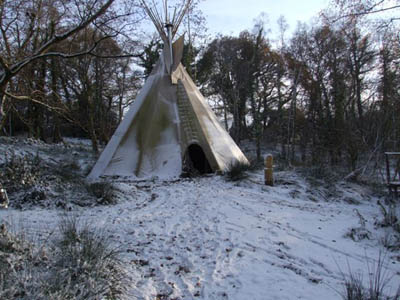
The trials and tribulations didn't stop there. Our heroic caterers, the Nettle Pickers, made it for the first three days but were snowed-in for the last two.  Time for 'Food Plan B' and back to the old days with my wife, Boo, preparing meals up at the farm and then transporting lunches down to the heated tipi on the back of the quad bike. That sounds like a good Plan B and in summer it would have been fine. In the snow though, the track down to the woods had become something akin to the Cresta Run in St Moritz. We had some very hairy moments balancing roast chickens whilst side-slipping down the chute on the quad. By luck and luck alone, all went well and lunches were enjoyed in the toasty-hot, log-burner-heated tipi on the last two days. Again, just a bit too close for comfort.


No, it doesn't stop there. There were the lithium battery drills that we discovered won't hold any charge when frozen, but this turned out to be quite easily solved with half an hour in the heated drying cabinet. There was also the small matter of cleaving - the wood was so brittle that cleaving was unpredictable to say the least; yet another steep learning curve for everyone.

But, for all of that, it was a magical week. The woods looked stunning and the atmosphere the whole time was really special. It was certainly a break with a difference for our guests.  Seven beautiful chairs were produced on time and I shall never forget the sight of everyone walking back through the floodlit woods in the snow and dark.  An hour after the course finished it started to rain and in no time all the snow had disappeared. It could have been a dream.

Friday, 12 November 2010

Oscar The Owl


If you receive our newsletter you'll know that Adam (one of the team) has been working on a 3D version of Oscar The Owl. I'm delighted to say he's now finished.

We're very fond of Oscar, designed by our friends at Big Fish Design and there's been an 'Oscar totem' half-carved for months, sitting patiently waiting to be finished during the totem courses. However, these have been so busy that he wasn't really progressing and so it came down to Adam to finish Oscar off.

Well, as you can see from the photos, Adam's done a fantastic job and Oscar is now greeting our guests and keeping a  wise eye on the goings-on in the workshop.

Congratulations Adam on a fantastic piece of carving, and thanks too to Karen Hansen for tutoring Adam on this part of his training as a full time green woodwork tutor.