Tuesday, 28 February 2012

In The Ether


We have started being active on Twitter and Facebook again as we now have some nice pictures and interesting goings on in the woods to post about. If you are into this sort of thing have a look at what we are up to here:


We have also been made aware of a relatively new site called Pinterest. I would be interested to hear if anyone else has being using this.

We only started on it last week but are finding it a very enjoyable way of categorising and storing interesting images of things we like or are interested in, be it for a specific project or just general interest.

I have been collating images of great treehouses and the collection so far can be seen here. 

Newly Available Course Dates


We have had a few guests who have had to move their bookings to later in the year. This means that at the time of writing we have one new place available on the May 10th-11th Bowl Carving Course and two new places on the April 23rd-27th ‘Make A Chair From A Tree’ course.

Call – 01460 221 102 - if either of these dates suit before they get snapped up again!

There are a few places still available on the other courses later in the year but do please act now as once they are full they are full.

We will be doing some more filming here this year (more details as and when), and I’m also going to be doing some teaching for the Architectural Association at Hooke Park, so it is unlikely that we will be releasing any additional course dates over and above the ones already advertised.  It really is a case of ‘book now for 2012’. 

Thursday, 3 February 2011

Hide Covered Coracles - The New Prototype


There are many styles of coracle attributed to various geographical locations and the rivers they are used on. The design I've been working on with Adam is very much based on the version I studied with Peter Faulkener last year, when Peter was so generously passing on his skills and knowledge.

Other variations, for instance, use ash laths instead of the woven coppiced willow and hazel we're using, and most makers for the last century have been using a calico and bitumescent paint 'skin', rather than the hide we're favouring.

The calico version is a perfectly valid alternative and is obviously much easier to achieve. It also has the advantage of being lighter to carry when you're sneaking down to the river with your salmon net under the cover of  darkness!

I have to say though that, given the choice of end product, I am happier using the hide that has been drying on its stretcher for the last few weeks, It may take a bit more time and effort but the end result has a timeless quality that harks back to ancient times and craftsmen. It is exactly these ancient skills that are so valuable for us to understand, document and preserve for future generations, so that they aren't lost for ever - as so many crafts have or are being.

The willow we use is from the withie beds that we planted at the Woodland Workshop just two years ago. Frankly, it is staggering how quickly the willow grows, producing a crop suitable for coracles every year.  The hazel comes from an eight-year rotation coppice on The Forde Abbey estate next door. The harvesting of the coppice is a seasonal activity when the leaves have fallen; a very satisfying winter job. We both have a lot more to cut yet for this year's season - the perfect way to spend a crisp February day.

Bending the hazel frame needs to be done with great care (if they snap they can be replaced but this is a tricky and frustrating process). It involves pulling the hazel with one hand to tension the bend as the other hand teases it to shape.  Many weavers would weigh the bent  hazel down for a period of days or even weeks to achieve the all-important flat bottom. However,  Peter Faulkener developed and taught me a very clever way of pulling the central run down with a Spanish lanyard prior to tying all of the marine twine knots. This in effect locks the lattice to shape and when the lanyards are unwound the whole structure stays the same shape - absolutely brilliant!

Once the structure is complete it is just a matter of going around with some sharp secatuers to snip off any sharp ends that may puncture the hide, and then a quick going-over with oil on the frame and oak seat completes the process.

The limed hide is then soaked to make it supple again and positioned over the frame, leaving a small gap at the back to drain any water out after use.  It is then cut to shape around the gunwale and laced in place using more wet leather strips.  Due to the shape it looks alarmingly baggy at this stage despite our best efforts to pull it tight. However, just a few days drying out and it's as tight as a drum with no more wrinkles to be seen.

The oak bark tannery that's supplying us (the only one in England) is just up the road, and I'm off to get some more hide next week. We need to be ready to demonstrate this stretching and drying when we're in the Green Field at Glastonbury Festival this year and - of course - we need hides for our coracle making courses this season too.  While I'm at the tanner I'll also be picking up some dubbin to seal and protect the outside.

And after all that work on the coracle, there's the question of the paddle. This is made from ash and requires our regular traditional green woodworking techniques with the drawknife and  spokeshave on the shaving horse - an oar is just a very big spatula after all!


Wednesday, 8 December 2010

Chair-Making In The Snow

The November/December chair making course was the last of our 2010 season. It will be remembered as one of the most eventful of all. Heavy and lasting snow in Dorset is a rare thing at any time, let alone in November, so I can only take my hat off to our seven hardy chair-makers for not giving up, battling against all the odds to get here and then going on to make seven beautiful chairs - on time and without a word of complaint.


I don't mind admitting we were really tested for the whole week, one way or another. The emergency calls from some of the guests needing collection from various places in the lanes between the main road and the Woodland Workshop set the tone!  Both Adam and I have Land Rovers so we were easily able to rescue guests from wherever their cars had become stuck, a pattern that continued throughout the week, both collecting and dropping off at various lay-bys and pubs.


Once here we were met with frozen pipes throughout the Woodland Workshop, but by day three we had the defrosting down to a fine art and this routine just became part of the daily fire lighting and tool sharpening preparation.  That said, it was nice to make use of the Kelly  Kettles again, heating our tea water at the beginning of the week.

Those readers that have been following our experimentation with boiling elm logs to remove the bark for the seating will know that we now have this cracked, so we can include bark stripping in winter when the sap is down. If only ...  With eight logs draw-knifed and scored ready for boiling, you can probably understand our disappointment - and mild panic - when, come Tuesday,  we discovered that however hot the boiling tank was, dropping a frozen log into it soon cooled it down and rendered it ineffective.

Yes, this did constitute a disaster, and there's no more stock of elm bark in the country, anywhere, even if it could have been delivered.

Time for 'Seating Plan B' - use leather strips instead.  It is pure good luck that the only oak bark leather tannery is just a few miles away and after a few frantic phone calls Adam was ready to brave the blocked lanes to go and collect enough leather sides and a very specialist saddle-maker's strip cutter to do the job.  It was all a bit too 'seat of the pants' for my taste but the end results were absolutely stunning. Indeed, so much so that we are now seriously considering using leather strips instead of bark on all future chair courses.

The trials and tribulations didn't stop there. Our heroic caterers, the Nettle Pickers, made it for the first three days but were snowed-in for the last two.  Time for 'Food Plan B' and back to the old days with my wife, Boo, preparing meals up at the farm and then transporting lunches down to the heated tipi on the back of the quad bike. That sounds like a good Plan B and in summer it would have been fine. In the snow though, the track down to the woods had become something akin to the Cresta Run in St Moritz. We had some very hairy moments balancing roast chickens whilst side-slipping down the chute on the quad. By luck and luck alone, all went well and lunches were enjoyed in the toasty-hot, log-burner-heated tipi on the last two days. Again, just a bit too close for comfort.
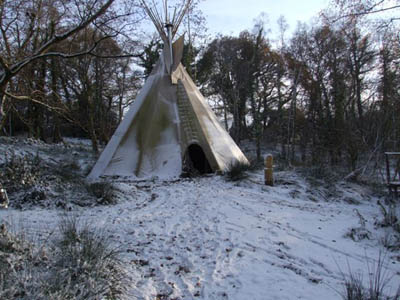

No, it doesn't stop there. There were the lithium battery drills that we discovered won't hold any charge when frozen, but this turned out to be quite easily solved with half an hour in the heated drying cabinet. There was also the small matter of cleaving - the wood was so brittle that cleaving was unpredictable to say the least; yet another steep learning curve for everyone.

But, for all of that, it was a magical week. The woods looked stunning and the atmosphere the whole time was really special. It was certainly a break with a difference for our guests.  Seven beautiful chairs were produced on time and I shall never forget the sight of everyone walking back through the floodlit woods in the snow and dark.  An hour after the course finished it started to rain and in no time all the snow had disappeared. It could have been a dream.

Friday, 12 November 2010

Oscar The Owl


If you receive our newsletter you'll know that Adam (one of the team) has been working on a 3D version of Oscar The Owl. I'm delighted to say he's now finished.

We're very fond of Oscar, designed by our friends at Big Fish Design and there's been an 'Oscar totem' half-carved for months, sitting patiently waiting to be finished during the totem courses. However, these have been so busy that he wasn't really progressing and so it came down to Adam to finish Oscar off.

Well, as you can see from the photos, Adam's done a fantastic job and Oscar is now greeting our guests and keeping a  wise eye on the goings-on in the workshop.

Congratulations Adam on a fantastic piece of carving, and thanks too to Karen Hansen for tutoring Adam on this part of his training as a full time green woodwork tutor.

Tuesday, 9 November 2010

Barking!


Although there are many options for the seating on the green wood chairs made on our popular 'Make A Chair From A Tree' courses, elm bark is easily my favourite. Working with it feels like you are weaving with leather and looks fantastic, as well as being relatively hard wearing.  Best of all, it is made from a part of a tree that is often discarded - something I find deeply satisfying.

In view of the difficulty in buying any more elm bark from our usual suppliers (we and other chair making friends have used the entire stock from the UK for this season) it seemed timely to try and make our own - something that we have been wanting to do for ages but never quite managed to get around to.

Smaller elm trees are surprisingly easy to source locally as they are not attacked by the Dutch elm disease carrying beetle when small, thus giving us the perfect excuse to fell and use them before they inevitably get the disease when larger. The problem is that the best time to peel the inner bark is when the sap is rising in the spring and we can't wait that long!

So, having taken the outer bark off with the drawknife we tried soaking for three days to see if that would help. It didn't. Then  steam was tried using a steam box for a day. It still didn't peel easily.  Obviously something more drastic was required so we then  tried boiling for a day, something we know works well with willow.

We made a trough and built a big fire below, then patiently waited and watched. The result? Success! It may not be as easy as peeling bark in the spring (we'll compare processes in a few months) but it does mean  that we can continue to make fresh bark throughout the coming winter courses and beyond - a great relief and, I think, a great additional aspect to our chair making courses.


Wednesday, 29 September 2010

Snow White In The Woods

In between running green woodworking courses here in the Woodland Workshop, we've held various events and also used it for some TV work and photo shoots. 

Our friends at Hiho Silver have just finished compiling their Autumn 'catapaper' (a cross between a catalogue and a newspaper, with photos taken in the woods.  The sight of Snow White and her dwarves, as well as Prince Charming and the rest of the cast, is one that shall stay with me for some time. I think it is obvious from the pictures that everyone had a good time, myself included ...


You can view the Catapaper here and the Hiho Silver web site here - both well worth a look as their silverware is something special.

Monday, 9 August 2010

The spirit of the true bodger

If you've kept up to date with our latest newsletter you'll probably have noticed the fantastic detailed drawings for a shaving horse that Martin Nicholson has shared with us.  I think it's really gratifying when someone who's been on a course is then inspired to take it further when they get home and, personally, I'm very impressed by the drawings. I'm also absolutely delighted that Martin himself has pretty well ignored them!

To explain, Martin's been helping to run a Scout camp in the New Forest, and during that he built a shaving horse on the first day entirely from materials scavenged from the site's wood pile. He used hot nails to make holes and came up with an alternative hinge design using some cord he found in the hedge.  If that's not the spirit of the true bodger then I don't know what is!  Wonderful stuff.


Tuesday, 20 July 2010

More Chair Making Successes

Last week saw the second full 'Make A Chair From A Tree' five-day course and I think I can say for sure that a great time was had by all.  And, in contrast to the last time we ran this one, we finished all 10 of the chairs just a couple of hours after 5.00 on Friday, a big improvement!  It was all quite (nicely) emotional at the end, with some justifiably proud guests.

Of the 10 guests we had six campers who had to endure some pretty torrential rain storms but in the true spirit of camping they still managed to enjoy themselves (with most of them ending up in the tipi for shelter I think). It must be said the Woodland Workshop's hot shower was put through its paces after the storms subsided.

I must say spending a week making a chair from a tree seems to be a particularly wonderful way to spend time ...  and if it appeals then don't forget the new course dates we've added for this year - there are still some places.


Thursday, 15 July 2010

New Course Dates

Of course we all dislike difficult decisions, but I've really struggled with this one. The bottom line is that there just aren't enough days in the year.

To be specific, the 'problem' is that we've experienced good - and growing - demand for pretty well all of our green woodworking oriented courses. (A nice problem to have!) However, this meant that for many people we just didn't have the course dates available to suit holiday arrangements etc, or in some cases there just weren't any dates left at all in 2010.

On the other hand, we've had considerably less demand for the non-woodwork-focused courses that we've introduced ... and as much as I am keen on broadening the overall scope of the Woodland Workshop, they were taking up a lot of the space in the diary.

So, and only after a lot of deliberation, I have decided to place the focus on green woodworking, cancel the other courses that were filling-up the diary, and thus offer more woodwork-related dates.

What that means is that I'm now able to offer these new course dates for 2010:  

Pole Lathe And Green Woodworking
Sep 13th/14th
Nov 1st/2nd

Carving A Wooden Bowl
Sep 27th/28th
Nov 4th/5th

Make a Chair From A Tree
Sep 20th-24th

As always, places are strictly limited so do book soon if any of these new dates tickle your fancy and suit your diary.

Of course, everyone booked on the cancelled courses has been contacted and refunded, and I do apologise for the disappointments. All I can say is that it was not a decision made lightly.

Phew. As always, it feels much better once a decision's been made!

See you in the woods soon.


Guy.

Wednesday, 7 July 2010

A Coracle In the Woods

I made my hide-covered coracle towards the end of June, guided by Peter Faulkner. However, for the best results the skin needs to dry before you take to the water. And so, about a fortnight later, the time came for my own coracle's maiden voyage, here on the lake in the woods. 


I will admit to some nerves - it's one thing to do this with an expert coaching you, quite another to do it all alone - but it was absolutely fine.  They're not the easiest of craft to get in or out of but I did it without falling it, and the satisfaction of paddling a boat you've made yourself  ... well, I strongly recommend you come and try it. Brilliant!


Recent Courses

We have been enjoying the glorious weather in the Woodland Workshop with a series of  full courses running back to back, including a very enjoyable bowl carving course in the summer sunshine.

I do advise guests to keep the still-green bowls out of direct sunlight, but the temptation was too much for them when it came to the group photo ...


The Pole Lathe course also went really well, with an incredibly productive group making lots of dibber, spurtles, spatulas and candle sticks as  well as some rather good lemon squeezers and rolling pins. Happy days,  and lots of people coming back for more - which is always very gratifying to hear.


Coracles In Herefordshire

At the end of June I spent an absolutely magical time with Peter Faulkner in Herefordshire. Peter is the only hide-covered coracle maker working in Britain today.

I've long been an admirer of Peter's work and I had hoped he would come to teach coracle making here in the Woodland Workshop. Unfortunately, I then discovered that he's just about to retire - which is nice for him, but rather scuppers my plan!

As you can probably imagine, I was therefore absolutely delighted when Peter very kindly suggested that he train me in this very ancient craft of making the greenest of vessels.

The process of building a coracle is relatively straight-forward - if carried out under the watchful eye of an expert - and by the time we'd finished weaving the willow and hazel and tied all of the joints we had an incredibly stiff lattice structure.


Working with a hide skin was a totally new experience for me and wonderfully direct, and with a bit of practice I got the hang of the lashing and ending up feeling inordinately proud of the end result. This is something that I see in our guests on a regular basis, and for once it was really nice to be on the receiving end of the satisfaction of learning something new and fulfilling.


As well as learning to make coracles, Peter also showed me the 'figure of eight' rowing technique and we tried this out for real on his local river - the perfect end to a experience I shall never forget and one that I'm looking forward to passing on to future coracle makers on our courses.

Peter's web site has some more details about his amazing achievements with coracles and currachs - boats that should never be underestimated!

Friday, 18 June 2010

Dorset Art Weeks

It has been great fun to be open to the public over the last two weeks as part of Dorset Art Weeks. We had many more visitors than expected and our pizzas (from our home made clay oven) and cider went down extremely well - more than 400 pizzas and five barrels of cider were consumed over the fortnight. Good food and drink in a woodland setting - perfect.  This blog by fellow furniture maker Simon Pirie helps give some of the flavour of the overall Dorset Art Weeks event.


Tom from Mastercrafts came and helped me which made it all the more enjoyable, and he's also been brushing up on his pole lathe turning and chair making in preparation to coming to help run courses here next month and again later in the year. Charlie also made a star appearance but sadly I missed the opportunity to get a photo of his (ahem) lovely colourful shirt.
DAW

My wife Boo's painting exhibition also went down very well and she almost sold out of paintings by the end. When you come down on a course, I recommend a visit to her studio up at the farm where you can have first choice of what she has been doing. (There's a link to her web site on the left!)

Friday, 11 June 2010

Mastercrafts Series 2 - Axed!

I have to say I was disappointed by the BBC's decision to not commission a second series of Mastercrafts. I say that not because I was a mentor on Series 1 but because I really do believe in craftsmanship, and Series 1 was a big step forward in showing to the public at large the pleasures to be had in all the crafts featured - not just green woodworking.

There is a Facebook Group set up specifically about this development

http://www.facebook.com/group.php?gid=133737523309730&ref=ts

and if you, like me, feel passionate about craftsmanship then perhaps you'll make your views known.

You can also read more about the issue (no Facebook participation required!), here:

http://ukhandmade.co.uk/magazine/petition

at UK Handmade.

Thursday, 3 June 2010

Masterclass 2 - Chairs From Trees

Our 'Make A Chair From A Tree' course has been very popular since our trainees on the BBC Mastercrafts program undertook the challange of making a chair from a tree in just 5 days.


Last week saw the first time of teaching it to a full house of 10 guests and I am delighted to report that at the end of it there were 10 beautiful chairs and 10 happy and rightfully proud chair makers.

We did have to work on into the evening to keep on schedule which, although not ideal, was great for the group as a whole and everybody rose to the challange.  Having said that, I am currently revising some details and processes so that on future courses everybody goes home on time!  

We had four campers all week and the new woodland shower has proven a real hit - not to mention the evening sessions in the dining tent with guitars, singing and campfires etc - a real escape from everyday life for all concerned.  I'd like to say well done to everyone and a heartfelt thanks too for the wonderful letters - they mean a great deal to us. 

For one guest, Aaron Hewit (recently back from a tour in Afghanistan), this was the last of four consecutive courses with us. He made a fantastic chair as his finale, as this picture shows:


Aaron's lovely basset hound and camper van will be much missed as will Aaron himself. I do hope he'll be back in the not too distant future for another few days in the woods.


Tom Vaughan from Mastercrafts is here in the workshop now, working with me on  refining this course and he'll be teaching on it when it's next run - which is next month. Personally I can't wait: the feeling of achievement really does seem to have affected everyone quite fundamentally.

Wednesday, 26 May 2010

Inaugural Masterclass

I had high hopes for our 'Masterclass' idea but you never really know until you try it. I'm pleased to say the first one, "Make A Pole Lathe & Shaving Horse", went really well. And at the end of it everyone went home with their own pole lathe and horse - including one set just fitting in to a Micra! (It was a bit of a squeeze.) I don't think I'd realised quite how many shavings we'd all create in a week!
 We knew it would be a lot of work for just a week and it was, but we all had a great time and it was a real bonus for me to be able to spend such a long time with the same group. Lots of new friendships emerged and some enthusiastic campers amongst the guests were immersed in the woodland experience for the whole week. Heaven!
 The next one of these courses is filling up quickly so if you have yearning to own your own lathe and horse and fancy a unique five day holiday too, do book up soon.  The course includes all materials including the solid oak pre-made lathe bed, poppets and stainless steel metalwork etc.

Making Gates

I'm pleased to say our first "Make A Chestnut Garden Gate" course went really well, with a full set of individual gates being designed and made in just two days. That's some going! Guy Furner is a natural teacher and between us we helped our guests create some really fantastic and beautiful gates for their gardens. It is always fascinating with all of the courses to see how varied the end products are and this was no exception.
The gates should last for years. They are held together with dried chestnut pegs and utilise the natural curves of the coppiced Chestnut that was harvested specifically for this course. 

Please Note: there are only a few places left on the course later this year, but we will be releasing one extra date for 2011 in the May edition of our monthly newsletter, so if you have a need for a special gate or fancy learning some new skills now would be a good time to book your place.

Primitive Pottery

Adam Hendley proved to be a natural teacher with his gentle style on our first primitive pottery course last week.  It was a girls-only affair which was unusual but fun for all.  I think everybody enjoyed digging our own clay from the stream in the Woodland Workshop and getting down and dirty!


Processing our own clay was a real eye opener to me and the wonder of watching our creations glowing red hot in our open fire pits was both an anxious and exciting moment.  There were all sorts of pots and effigies and beads etc made,  many of which were decorated with imprints of leaves and petals.  I made time at the end to make a 3d version of Oscar the Owl as a model for a really large one that Karen Hansen and I will be carving over Dorset Art Weeks.


The feedback from all of the guests on this course has been fantastic and it was great to see so many campers .. but where did all that left over home made cake go?  I have seen a few crumbs in the Tipi.....it must be all that "hyperthermalating" after the cider!

The Cloud Factory blog (see right) has a more information about 'primitive pottery' if you'd like to learn more.

The Nettle Pickers

There's a new team preparing food in the woods: Vicky, Joy and Anna (collectively known as 'The Nettle Pickers') have taken over the new dining tent and are producing fantastic lunches for all courses and events. All of our guests this year have enjoyed watching meals being cooked in the woods throughout the mornings, before each day's lunch extravaganza. The ingredients are all local and fresh and include lots of seasonal foraged elements too. When possible organic is preferred and mixed with spices from around the world.

The Nettle Pickers are part of our local farming and smallholding community and are perfectly placed to find the best of what's on offer at any time of year - with the result that guests (and the team) are getting really delicious, imaginative healthy food every day.